
Gold Ore Grinding: Sizing the Mill for Gold Liberation

Key takeaways
- Grinding sets the ceiling on gold recovery. No leach or gravity circuit can recover gold that grinding never liberated.
- Grind to liberation, not to the finest size. Over-grinding creates slimes that cost money twice — once to make and once to lose.
- Circuit type matters as much as mill size. A close circuit with a classifier gives far better control than a once-through arrangement.
- Grinding is the biggest energy consumer in the plant. Small sizing errors multiply into large power bills.
- Test work sets the target. The fineness of grinding should come from laboratory results, not from habit.
Gold does not come out of the ground as free metal dispersed through powder. It sits inside rock, and until that rock is broken down far enough to expose the gold, nothing downstream can recover it. Grinding is the stage that makes recovery possible — and the stage where most of a plant’s energy is spent.
Sizing a mill for a gold project therefore comes down to one question: what fineness of grinding does this ore need to reach an economic liberation degree?
Why grind size decides everything downstream
Every recovery method has a size range it can handle. Gravity separation needs gold particles coarse enough to settle. Flotation needs sulphide grains large enough to attach to a bubble. Cyanidation needs gold exposed to solution. All three depend on liberation, and liberation is what grinding delivers.
But grinding too fine causes its own problems. Fine particles leach more slowly, thicken badly, and are lost from gravity circuits. Grinding past the point of liberation consumes energy and reagents to produce material that is harder to recover, not easier. The optimum is the coarsest grind that achieves adequate liberation — not the finest grind the mill can produce.
Choosing the grinding circuit
| Circuit | Configuration | Best for |
|---|---|---|
| Rod mill | Rod mill, often open circuit | Coarse, even product ahead of gravity or flotation |
| Ball mill, close circuit | Ball mill with classifier or Hydrocyclone returning oversize | Fine grinding with tight size control |
| Ball mill, open circuit | Once-through grinding | Simple circuits where size control is not critical |
| Two-stage | Rod mill followed by ball mill | Large plants needing staged reduction |
| Conical ball mill | Mill with classifying zone along the shell | Smaller plants wanting classification built in |
For most gold plants, a ball mill in close circuit with a classifier or Hydrocyclone is the standard arrangement. The classifier returns oversize to the mill, which allows tight control of the product size at lower energy cost than an open circuit, where particles can pass through before they are ground sufficiently.
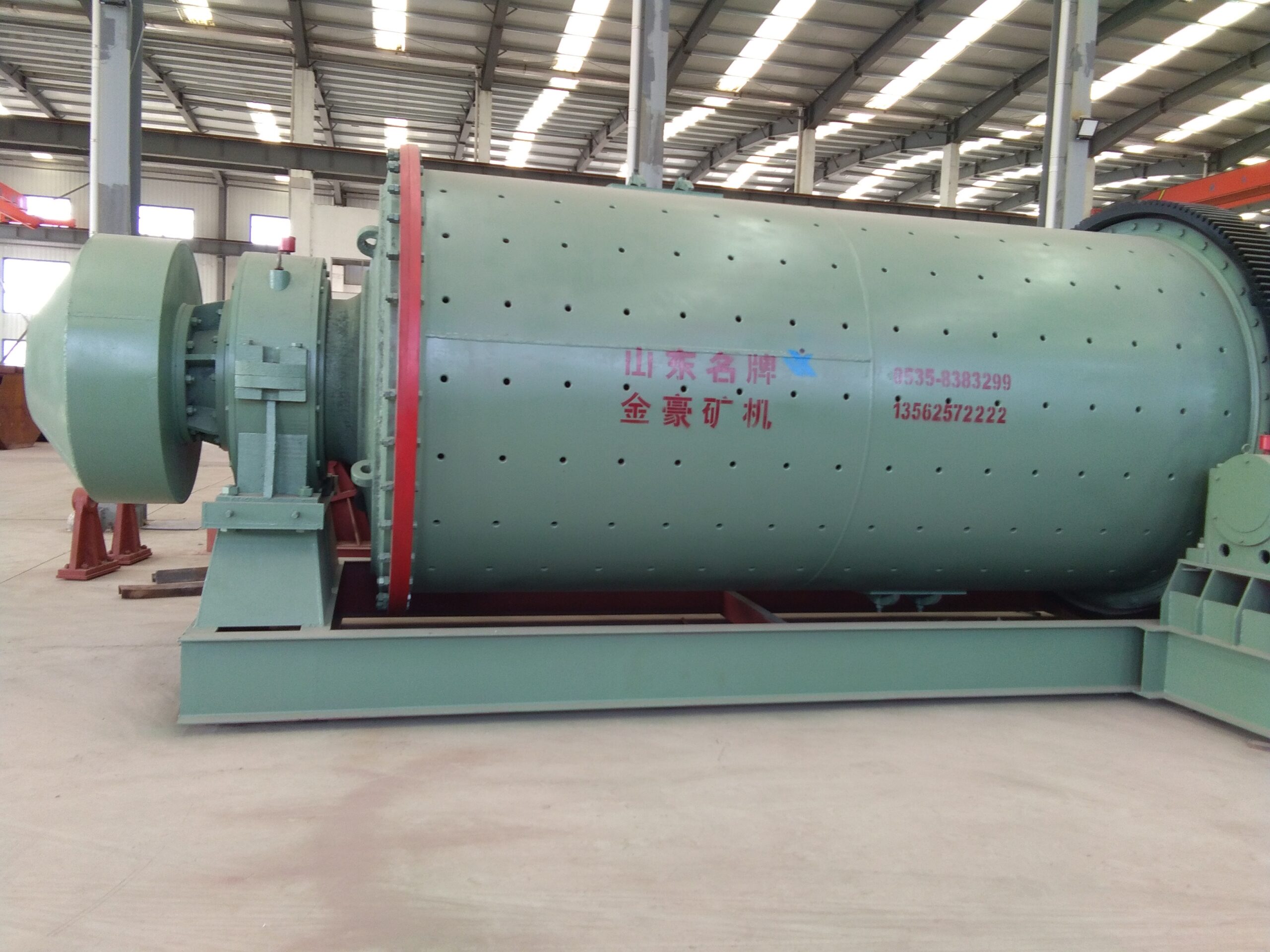
Where the ore is coarse and the product needs to be relatively even, a rod mill can be used instead, or ahead of the ball mill. Rod mills produce fewer slimes because they grind by line contact rather than point contact, which suits circuits that will feed gravity or flotation.
Sizing the mill
Mill sizing starts from three inputs: the tonnage to be ground, the feed size entering the mill, and the target product size. From those, the specific energy required can be estimated — usually from laboratory grindability testing — and the mill power follows.
Two practical points matter. First, feed size to the mill depends heavily on the crushing circuit: a finer crusher product means less work for the mill, and because crushing is far more energy-efficient than grinding, pushing reduction upstream often cuts total power. Second, the circulating load in a close circuit affects mill capacity, so the classifier must be sized to return oversize reliably rather than to let it pass.
Two operating parameters sit behind those numbers. Mill speed is normally set between 50 and 90 percent of critical speed — the point at which the charge would centrifuge against the shell. Capacity keeps rising with speed, but energy efficiency does not: above roughly 40 to 50 percent of critical speed, extra speed buys throughput rather than a lower kWh per tonne. The other parameter is the grinding charge itself, which occupies slightly less than half the mill volume. A charge that cascades at low speed grinds mainly by abrasion, producing a finer product, more slimes and more liner wear; a charge that cataracts at high speed grinds mainly by impact, producing a coarser product with less liner wear.
What sets the target grind size
The right fineness of grinding comes from test work, not from a rule of thumb. A standard programme combines grindability testing — which establishes how much energy the ore needs — with recovery testing at several grind sizes, which shows how recovery responds. Plotting recovery against grind size reveals where the curve flattens: beyond that point, finer grinding costs money without returning it.
The answer varies enormously between ores. A coarse, free-milling gold ore may need relatively coarse grinding, while an ore with finely disseminated gold may require very fine grinding indeed to reach an economic liberation degree.
Grinding media and liners
Once the mill is sized, its operating cost is driven by the grinding charge and the mill liner. Media size must match the feed and the target product: too large and the mill over-grinds and damages liners, too small and it cannot break the incoming particles. Liner profile affects the motion of the charge, which in turn affects grinding efficiency.
Managing these deliberately — top-up rates, media size distribution, liner change timing — is what keeps grinding cost per tonne under control. You can review the equipment in our grinding equipment range, including the cylindrical ball mill used in most gold plants.
Rule of thumb: crush as fine as you can and grind only as fine as you must. Crushing is far cheaper per unit of size reduction than grinding, and every micron of unnecessary grinding is paid for in power and lost recovery.
Frequently asked questions
How fine should I grind gold ore?
Fine enough to liberate the gold economically — no finer. The correct target comes from recovery testing at several grind sizes to find where the recovery curve flattens. Grinding beyond that point adds cost and creates slimes without improving recovery.
What is the difference between open and close circuit grinding?
In a close circuit, a classifier returns oversize particles to the mill, so the product size is tightly controlled. In an open circuit, material passes through once. Close circuits give better size control and usually better energy efficiency, which is why most gold plants use them.
Ball mill or rod mill for gold ore?
Ball mills are the general choice for fine grinding of gold ore. Rod mills produce a more even, coarser product with fewer slimes and are preferred ahead of gravity or flotation, or as a first stage in a two-stage circuit.
Why is grinding the most expensive part of a gold plant?
Because comminution consumes far more energy than any other unit operation. The power drawn by the mill usually dominates the plant’s electricity bill, which is why grind size optimisation has such a large effect on operating cost.
How does crushing affect mill sizing?
A finer crushed product means less grinding work, so the mill can be smaller or run at lower power. Because crushing is much more energy-efficient than grinding, pushing size reduction upstream into the crushing circuit usually reduces total comminution energy.
Sizing a grinding circuit for a gold project? Send us your grindability and recovery test results and we will specify the mill.
Talk to a Jinhao engineer