
Alluvial Gold Mining: Recovering Fine Gold from River Deposits
Key takeaways
- Alluvial gold is already free, so no comminution is needed — but only if the clay is broken down first.
- Washing and screening come before concentration. A concentrator fed with a mixed, clay-bound slurry will lose gold no matter how good it is.
- Classify before you concentrate. Narrow size fractions let jigs, shaking tables and centrifugal concentrators each work at their best.
- Fine gold is the hard part. Below roughly 100 mesh, gravity recovery falls off sharply unless centrifugal concentrators are used.
- Water is the constraint. Alluvial plants need consistent flow and a closed water circuit, especially in dry regions.
Alluvial gold mining looks like the simplest form of gold recovery, and in principle it is: the gold has already been liberated by nature, so there is nothing to crush or grind. In practice, alluvial plants are where a great deal of gold is lost, because the feed is wet, sticky, variable and full of fines.
This guide covers how alluvial gold is recovered, in what order, and where the losses usually happen.
What alluvial gold is
Alluvial deposits — also called placer deposits — form when a primary gold occurrence is weathered and eroded, and rivers carry the liberated gold downstream. Because gold is dense and chemically stable, it settles where the water slows: on bedrock, behind boulders, and in gravel bars. What remains is gold dispersed through sand, gravel and clay, from coarse nuggets near the source to fine flakes far downstream.
For a mining operation the important consequences are that the gold is free, the material is loose rather than solid rock, and the feed contains a wide and unpredictable range of particle sizes.
The alluvial flow sheet, stage by stage
| Stage | Equipment | What it achieves |
|---|---|---|
| 1. Scrubbing and washing | Rotary trommel or scrubber with water | Breaks up clay and liberates gold from cemented gravel |
| 2. Screening | Trommel or vibrating screen | Splits feed into coarse and fine fractions |
| 3. Classification | Screens, Hydrocyclone | Narrows particle size for the concentrators |
| 4. Coarse recovery | Jig | Catches coarse gold in the gravel fraction |
| 5. Fine recovery | Shaking table, spiral chute | Concentrates medium and fine fractions |
| 6. Slimes recovery | Centrifugal concentrator | Captures fine and flaky gold that gravity otherwise loses |
| 7. Water management | Thickener, settling pond | Recycles process water and controls discharge |
Stage 1: Scrubbing and washing
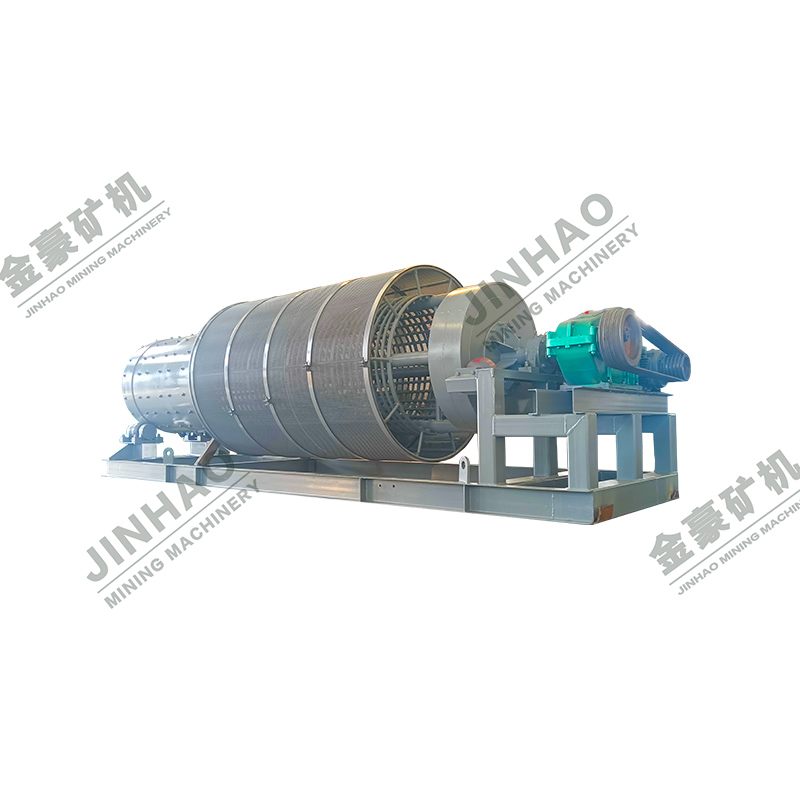
This is where alluvial plants succeed or fail. Clay binds fine gold into lumps that behave like gravel, and those lumps will pass straight over a concentrator. A rotary trommel with internal lifters and plenty of water, or a purpose-built scrubber, breaks the clay apart and releases the gold so the rest of the circuit can see it.
Stage 2 and 3: Screening and classification
Screening splits feed by size, typically at a few millimetres, sending oversize to a coarse recovery stage and undersize to fine treatment. Classification then narrows the size distribution further. This matters because every gravity device has a size band it handles well: a trommel screen and jig suit coarse feed, while tables and spirals need a tighter, finer cut.
Feed a jig with unscreened material and the fines simply wash out; feed a shaking table with coarse gravel and the gold never separates. Size classification is what makes each stage work.
Stage 4 to 6: Gravity concentration
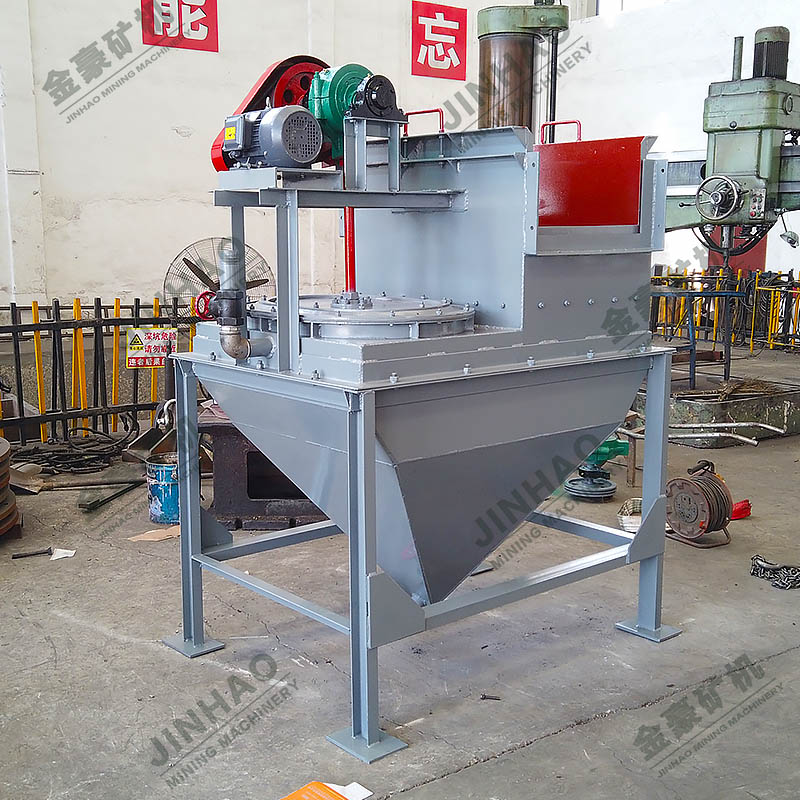
Concentration step by step gets progressively finer. Jigs handle the coarsest fraction, using a pulsating water bed to stratify dense gold from lighter gravel. Shaking tables and spiral chutes take the medium to fine fraction, separating particles by density and shape. For the finest fraction — and for the flaky gold that tables struggle with — a centrifugal concentrator applies high G-force to capture particles that would otherwise report to tailing.

Why fine gold is the real problem
Coarse alluvial gold is straightforward: it is dense, it settles fast, and almost any gravity device will catch it. Fine gold is the opposite. Once particles drop below roughly 100 mesh, they settle slowly, respond to water turbulence rather than density, and escape even well-designed circuits.
Three things make the difference. First, remove as much fine slime as possible before concentration, because slimes raise pulp viscosity and destroy the settling difference between gold and gangue. Second, use centrifugal concentration for the fine fraction rather than relying on tables. Third, keep the water balance steady — fluctuating flow is what flushes fine gold out of the circuit.
There is a hard physical limit behind this. Gravity separation depends on particles settling at different rates in water, and that difference collapses as particles get smaller — below roughly 50 microns the settling behaviour of gold and of ordinary sand becomes too similar for gravity to exploit reliably, and sluice boxes fall away well above that limit. This is why the answer to fine gold is almost always better classification and centrifugal concentration, rather than a longer sluice.
Water management in alluvial plants
An alluvial plant uses a lot of water, and in many gold-bearing regions water is the binding constraint. A closed circuit that recycles process water is standard practice: concentrate and tailing streams report to a thickener, clarified water returns to the washing stage, and only a small volume is made up.
This addresses two problems at once. It reduces the fresh water demand, which may be the difference between a viable project and a stalled one, and it keeps the plant’s discharge within environmental limits. Alluvial operations near rivers are watched closely, and a settling circuit is usually a permit condition rather than an option.
Rule of thumb: in alluvial gold, recovery is decided before the concentrator. Break the clay, screen the feed, classify it — then let gravity do the easy part.
Frequently asked questions
Do alluvial gold plants need crushing or grinding?
No. Alluvial gold is already liberated from its host rock, so there is nothing to crush or grind. The equivalent preparation step is washing and scrubbing to break up clay, followed by screening and classification.
What is the best equipment for fine alluvial gold?
Centrifugal concentrators are the most effective device for fine and flaky gold. They should be fed a deslimed, classified slurry; feeding them unscreened material reduces recovery sharply.
How much water does an alluvial gold plant use?
It depends on the feed and the washing requirement, but alluvial plants are water-intensive by nature. Most modern plants run a closed loop with a thickener and settling pond so that process water is recycled rather than discharged.
Why is my sluice losing fine gold?
Usually because the feed is too variable or too slimy. Slimes raise viscosity and stop fine particles from settling, while fluctuating flow re-suspends settled gold. Classification ahead of the sluice and steady water flow are the usual fixes.
Can alluvial gold be recovered without chemicals?
Yes. Alluvial circuits rely on gravity concentration and need no reagents at all. That is one of their main advantages over hard-rock processing, both in cost and in environmental permitting.
Planning an alluvial or placer gold plant? Send us your feed size, clay content and target capacity for a tailored circuit.
Talk to a Jinhao engineer