

Merrill-Crowe vs Carbon Processes for Gold Recovery

Key takeaways
- Both routes recover gold from cyanide solution. One uses zinc dust, the other activated carbon.
- Carbon suits most gold plants, particularly where the silver-to-gold ratio is low.
- Merrill-Crowe suits high silver-to-gold ratios and produces a very clean doré.
- Merrill-Crowe needs clear solution, so it works with heap leach and filtration rather than with pulp.
- Solids handling is the dividing line. Carbon handles pulp; zinc precipitation cannot.
Once gold is dissolved in cyanide solution, it has to be taken out of that solution. Two technologies dominate: adsorption onto activated carbon, and precipitation with zinc dust — the Merrill-Crowe process. They are not interchangeable, and choosing the wrong one for your ore and flowsheet has consequences that run through the whole plant.
The two processes in outline
Carbon adsorption
Activated carbon adsorbs dissolved gold from the cyanide solution. Because carbon can be kept in contact with pulp, it works directly on leach slurry in CIL and CIP circuits, removing the need to separate solids from solution first. Loaded carbon is then eluted and the gold recovered by electrowinning.
Merrill-Crowe (zinc precipitation)
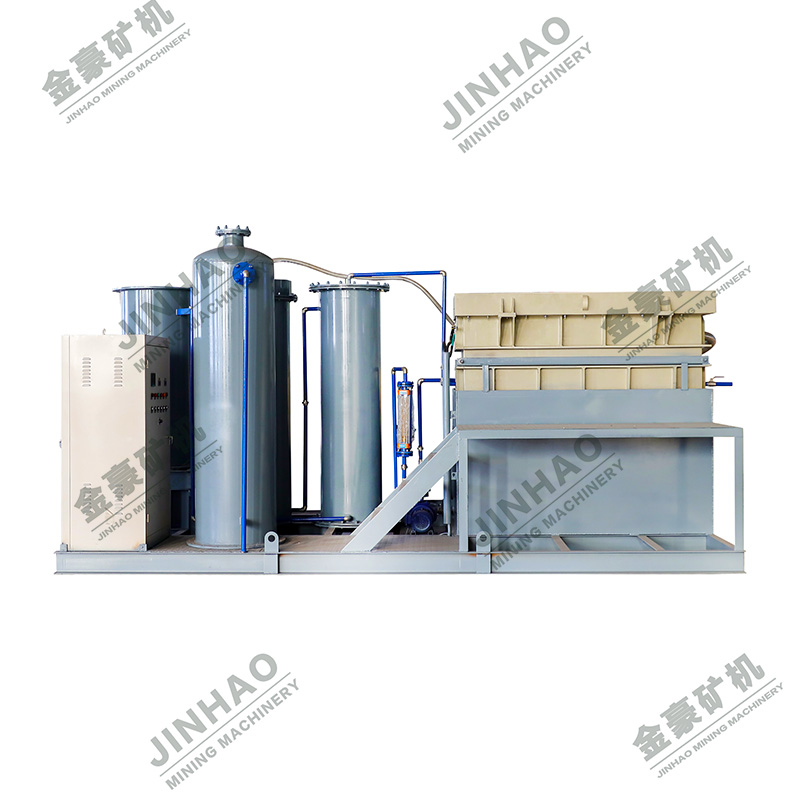
In the Merrill-Crowe process, gold-bearing solution is clarified and then deaerated — oxygen must be removed, because it interferes with the precipitation reaction. Zinc dust is added to the deaerated solution, and the gold and silver are precipitated as a fine metallic sludge, which is filtered, dried and smelted.
| Factor | Carbon adsorption | Merrill-Crowe |
|---|---|---|
| Feed form | Pulp or clear solution | Clear, deaerated solution only |
| Silver recovery | Lower — carbon is much more selective for gold | High — silver precipitates alongside gold |
| Product | Loaded carbon, eluted to a concentrated solution | Precipitated sludge, filtered and smelted |
| Circuit complexity | Elution and electrowinning required | Clarification, deaeration, precipitation, filtration |
| Suits heap leach liquors? | Yes | Yes, and often preferred |
| Suits high-silver ores? | Less well | Yes |
| Oxygen sensitivity | Requires oxygen for leaching, not for adsorption | Oxygen must be removed before precipitation |
When carbon is the better choice
Carbon dominates modern gold plants for a straightforward reason: it accepts pulp. In a CIL or CIP circuit, the leach and the recovery step are integrated, so there is no need to filter the entire ore stream to obtain clear solution. That eliminates a large, expensive and difficult solids-liquid separation stage.
Carbon also handles the very dilute solutions typical of large gold plants well, and it tolerates a fair amount of suspended solids. Where the ore is a straightforward gold ore with a low silver content, carbon is almost always the right answer.
Its weakness is silver. Activated carbon adsorbs silver far less selectively than gold, so in ores with a high silver-to-gold ratio, a carbon circuit can leave a meaningful amount of silver unrecovered — a real loss of revenue.
When Merrill-Crowe is the better choice
Merrill-Crowe comes into its own in three situations.
First, high silver content. The zinc precipitation reaction is not selective, so both gold and silver report to the sludge, which is exactly what you want when silver is a significant by-product credit.
Second, when clear solution is already available. Heap leach operations produce clear pregnant liquor, so the clarification step Merrill-Crowe requires is already partly in place. The same applies to plants that filter their pulp for other reasons.
Third, where a very clean product is wanted. Merrill-Crowe produces a high-grade precipitate that smelts directly, which some operators prefer to the elution and electrowinning chain that carbon requires.
It is also worth noting that many operations use both. A heap leach may precipitate with zinc, while an adjacent mill runs a carbon circuit — the two are complementary rather than competing.
How to decide
The decision usually follows from the flowsheet rather than from preference. If the plant will leach pulp, carbon is the only practical option, because Merrill-Crowe cannot handle solids. If the plant produces clear solution — heap leaching, or a filtered circuit — both are possible and the comparison is economic, driven mainly by the silver content of the ore and the cost of zinc and clarification.
Test work should establish both the expected silver-to-gold ratio and the precipitation or adsorption efficiency, because the answer can be counterintuitive. Our notes on carbon-in-pulp processing cover the carbon side in more detail.
Rule of thumb: if you are processing pulp, choose carbon. If you have clear solution and a high silver-to-gold ratio, look seriously at Merrill-Crowe.
Frequently asked questions
What is the Merrill-Crowe process?
It is a gold and silver recovery method in which clarified, deaerated cyanide solution is treated with zinc dust. The precious metals precipitate as a fine sludge, which is filtered and smelted. It requires clear solution, so it cannot be applied directly to leach pulp.
Why does Merrill-Crowe need deaerated solution?
Because dissolved oxygen interferes with the precipitation reaction and consumes zinc. The solution is deaerated under vacuum before zinc is added, so that the reagent acts on the precious metals rather than being wasted on oxygen.
Which process is better for silver-rich ore?
Merrill-Crowe generally performs better on ore with a high silver-to-gold ratio, because zinc precipitation recovers both metals together. Activated carbon is much more selective for gold, so a carbon circuit can leave significant silver unrecovered.
Can I use both carbon and Merrill-Crowe in one operation?
Yes, and some sites do. A heap leach producing clear pregnant liquor might use zinc precipitation, while an adjacent milling circuit treating pulp uses carbon. The two processes address different feed conditions rather than competing directly.
Is Merrill-Crowe still used?
Yes, particularly in silver-rich operations and at heap leach facilities where clear solution is readily available. It remains a well-established route with a long track record in precious metal recovery.
Choosing between carbon and zinc precipitation? Send us your solution assays and flowsheet and we will help you compare.
Talk to a Jinhao engineer