

Gold Cyanidation: How Cyanide Leaching Recovers Gold
Key takeaways
- Cyanidation dissolves gold into solution. In the presence of oxygen, cyanide forms a soluble gold complex that can be recovered downstream.
- Four variables decide the rate: cyanide concentration, dissolved oxygen, pH and residence time.
- Grinding sets the ceiling. Cyanide can only dissolve gold that grinding has exposed.
- Cyanide consumers are the enemy. Copper minerals, sulphides and carbonaceous matter all rob the leach of reagent or gold.
- Recovery above 90% is achievable on free-milling ore when the circuit is properly controlled.
Cyanidation has been the backbone of gold recovery for well over a century, and despite decades of research into alternatives, it remains the only commercially proven method for dissolving gold from ore at scale. Its dominance comes down to a simple fact: cyanide forms a stable, soluble complex with gold, and no other cheap reagent does the same job as effectively.
This article explains how the process works and, more usefully, which plant conditions decide whether it works well.
The chemistry in plain terms
The overall reaction is well understood. In the presence of dissolved oxygen, cyanide dissolves metallic gold to form a soluble dicyanoaurate complex, while the oxygen is reduced to hydroxide. Two things follow from this equation that matter on the plant floor.
First, oxygen is not optional. Cyanidation needs both cyanide and dissolved oxygen at the same time, and in practice oxygen is very often the limiting factor rather than cyanide. Sparging air into the leach tanks is standard, and oxygen enrichment is used where kinetics are slow.
Second, the reaction consumes alkali. Hydroxide is produced and the pH tends to rise, but the surrounding chemistry — particularly the formation of hydrogen cyanide gas at low pH — means the leach is deliberately run alkaline to prevent cyanide loss and to protect workers.
The variables that decide recovery
| Variable | Typical target | What happens if it is wrong |
|---|---|---|
| Grind size / liberation | Set by ore mineralogy and test work | Locked gold never dissolves, however long the leach runs |
| pH | Alkaline, typically 10–11 | Too low: cyanide lost as HCN gas, safety risk. Too high: slower kinetics, higher lime cost |
| Dissolved oxygen | Maintained by aeration or oxygenation | Oxygen-starved leach slows sharply regardless of cyanide level |
| Cyanide concentration | Controlled to a target residual | Too low: incomplete dissolution. Too high: wasted reagent, higher detoxification cost |
| Residence time | Set by leach kinetics from test work | Too short: gold leaves in the tailing |
| Pulp density | Balanced against mixing and viscosity | Too thick: poor mixing and oxygen transfer. Too thin: more tankage, more reagent |
Grinding: the ceiling on recovery
No leach can dissolve gold it never touches. The fineness of grinding therefore sets an upper limit on cyanidation recovery, and this is why gold plants spend so much effort on grinding circuits. The goal is not the finest possible grind, but the grind that achieves the required liberation degree without creating a flood of slimes that slows settling and complicates thickening. There is an important counterpoint, though: because the reaction takes place at the gold surface, leach kinetics depend on exposed surface area. Gold circuits can therefore justify grinding finer than a base-metal circuit would, and over-grinding is penalised less in gold than it is elsewhere.
Oxygen: the variable most often neglected
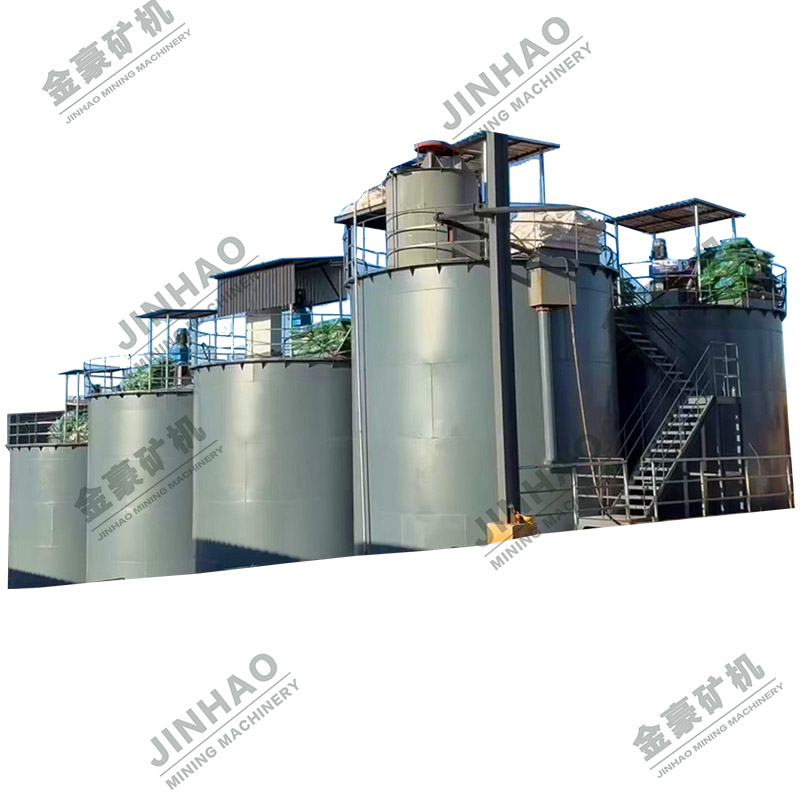
Many underperforming leach circuits are short of oxygen rather than cyanide. Air sparging introduces oxygen, but transfer efficiency depends on agitator design, tank geometry and pulp density. In high-grade or fast-leaching circuits, oxygen enrichment can be justified, and it usually shows up as a faster leach rather than a higher ultimate recovery.
Cyanide consumers
Ore minerals that react with cyanide raise reagent cost and can depress gold recovery. Copper sulphides are the most common problem; pyrrhotite and some iron sulphides also consume cyanide, and carbonaceous material adsorbs dissolved gold. Measuring cyanide consumption per tonne in a lab leach is essential — an ore that consumes heavily may be uneconomic no matter how much gold it contains.
Where cyanidation sits in the circuit
Cyanidation is rarely the whole plant. In a typical flow sheet, ore is crushed and ground, coarse free gold is removed by gravity or flotation, and the remaining pulp is leached. In a CIL circuit, activated carbon is added directly to the leach tanks so that dissolved gold is adsorbed as soon as it forms; in a CIP circuit, leaching and adsorption happen in separate stages.
After adsorption, loaded carbon is stripped in an elution circuit and the gold is recovered by electrowinning before smelting. Our overview of gold CIP processing covers that route in detail.
Environment and safety
Cyanide is acutely toxic, and its handling is regulated almost everywhere. Modern practice addresses this in three ways: keeping the circuit alkaline so hydrogen cyanide gas is not formed, containing and recycling process water in a closed circuit, and destroying residual cyanide before tailing is discharged. Detoxification using sulphur dioxide and air, peroxide, or Caro’s acid is standard and is usually a condition of the operating permit rather than an optional improvement.
Rule of thumb: if a leach is underperforming, check oxygen before adding cyanide. Reagent is easy to measure, which is exactly why oxygen starvation is so often missed.
Frequently asked questions
What is gold cyanidation?
It is the process of dissolving gold from ore using a cyanide solution in the presence of oxygen, forming a soluble gold complex. The dissolved gold is then recovered from solution by adsorption onto activated carbon or by zinc precipitation.
Why is oxygen important in cyanide leaching?
Because the dissolution reaction requires both cyanide and dissolved oxygen. If oxygen is limited, the leach slows regardless of how much cyanide is present. In practice, oxygen shortage is a more common cause of poor recovery than cyanide shortage.
What pH should cyanide leaching run at?
Alkaline, typically around pH 10 to 11. Running more acidic risks losing cyanide as hydrogen cyanide gas, which is both a reagent loss and a serious safety hazard. Lime is the usual alkali.
How long does cyanide leaching take?
It depends on the ore. Fast-leaching free-milling ore may reach high recovery in 12 to 24 hours, while slow or partially refractory ore can require 48 hours or more. Leach kinetics are established by laboratory test work, not assumed.
Is cyanidation still used today?
Yes. Despite extensive research into alternatives such as thiosulphate and glycine, cyanidation remains the dominant industrial method for gold recovery worldwide because it is effective, well understood and relatively inexpensive.
Planning a cyanidation circuit? Send us your leach test work and we will size the tanks, agitators and carbon circuit.
Talk to a Jinhao engineer